· Property Assessments for Landlords Services Ltd (PALS)
If guests pay to stay in your holiday let, even for one night, the Fire Safety Order normally applies and you need a written fire risk assessment. For a small cottage in Cornwall, the Home Office guide typically recommends interlinked smoke and heat alarms and a protected hall and stairs. It also covers exit doors that open from inside without a key, torches or night lights for a power cut, and fire information for guests.
By small, the guide means houses, cottages and chalets on the ground floor, or ground and first floor, that sleep up to 10 people with no more than four first-floor bedrooms, and most individual flats. Whether you can do the assessment yourself is a separate question.
Does a holiday let or Airbnb need a fire risk assessment?
The Home Office guide, Making your small paying guest accommodation safe from fire, is direct: “The law (FSO) applies to you if you are charging someone to stay in your property as a guest and it is not being occupied as a private dwelling, even if it is just for one night.” It adds that your responsibility applies however you advertise the property. A listing on Airbnb or a similar site is no exception.
Article 9 of the Regulatory Reform (Fire Safety) Order 2005 requires a “suitable and sufficient assessment of the risks”, and since 1 October 2023 it must be recorded in full, with all of its findings. The duty usually sits with the owner or operator: see who is responsible.
Much of what people call the fire regulations for holiday lets is guidance: the guide says the Order “does not prescribe the specific fire safety measures required”. Its duties on alarms, firefighting equipment and emergency lighting apply “where necessary”, and your assessment is how you identify what is necessary. The guide, updated in January 2025, uses “must” when indicating compliance with the law and “should” for recommendations.
Do holiday lets need smoke alarms?
For a small holiday let, the guide recommends interlinked domestic alarms rather than a hotel-style system:
- Smoke alarms — in hallways, corridors, staircases, lounges, dining rooms and bedrooms.
- Heat alarms — in every kitchen, and in utility or laundry rooms where a smoke alarm might give false alarms.
- Mains power — with a tamper-proof battery back-up (Grade D1). Where mains alarms are not yet fitted, sealed long-life battery alarms (Grade F1) “may be acceptable as a short-term measure”, which the guide puts at around two to three years.
Escape routes and inner rooms
In the guide's two-storey house and cottage examples, the entrance hall and stairs should form a notional 30-minute fire-protected escape route. Exit doors “must not need a key to unlock them from the inside”.
An inner room is one where the only way out is through another room, as in our holiday cottage case. The guide says an inner room should not be used for sleeping unless it is on the ground floor, with direct access to a door or escape window. It also says first-floor escape windows are not a safe way out for paying guests.
Do holiday lets need fire doors? Not always
In the guide's house and cottage examples, doors onto the protected hall and stairs should be notional fire doors but “do not need to be self-closing”. It says solid, conventional doors that are a good fit in their frames can usually be accepted, typically 44mm solid timber or with a flaxboard or chipboard core. Intumescent strips and smoke seals are “not considered essential”. Hollow-core and thin panel doors, and plain glazing in doors, will normally need replacing with 30-minute fire-resisting doors.
Do holiday lets need emergency lighting?
The guide says you must provide emergency escape lighting on routes guests would have to use in darkness if the mains power failed, where necessary for their safety. In the smallest premises, rechargeable torches that light automatically in a power cut may be acceptable, one per bedroom with a sign explaining their function. Its house and cottage examples also accept plug-in night lights on the stairs and entrance hall.
Do holiday lets need fire extinguishers?
The guide says “evacuating the premises is the safest thing to do”. For self-catering, it says “you may wish to provide a small fire extinguisher and/or fire blanket in the kitchen area”, and its house and cottage examples list both as optional. If staff work at the property or visit regularly, it says firefighting equipment should be provided and staff trained to use it. On type, its studio flat example lists “A multi-purpose fire extinguisher (not dry powder)”.
Heating, log burners, candles and electrics
The guide recommends annual maintenance of heating and hot water systems. With an open fire or log burner, it recommends a spark guard, a metal ashbin and a chimney swept at least annually. It says carbon monoxide detectors should be provided where there is a gas or solid fuel-burning appliance. It also says you “should not provide candles, tea lights or ethanol burners for use by guests”.
On electrics, the guide says “You must make sure that your electrical wiring has been checked by a qualified contractor”. It recommends inspection and testing at least every five years; the report is usually an EICR. For appliances, it recommends regular checks in line with manufacturers' instructions and a visual check between lets. It does not use the term PAT testing, but for bed and breakfast and similar accommodation it recommends periodic in-service inspection and testing of appliances.
Fire information for guests
The guide says fire procedures must make guests aware of what to do, as someone staying “is unlikely to be familiar with the premises.” It suggests a simple plan drawing, instructions on the back of bedroom doors and a welcome pack, covering:
- What to do — a fire action notice, including leaving by the nearest available exit.
- The way out — the escape route and where the exit doors are.
- Calling for help — how to contact the emergency services, with the correct address and postcode, and location details if the postcode might not pinpoint the property.
What to check between guests
Where no owner or staff are present, the guide recommends its weekly and monthly tests at each change of occupancy. That is a recommendation, not a legal timetable; the legal duty, under article 17, is to keep fire safety equipment, where necessary, maintained and in efficient working order. A changeover check might cover:
- Alarms — each smoke and heat alarm tested, and loud enough to wake someone asleep.
- Torches or escape lights — working, with bedroom torches and their signs in place.
- Escape routes — clear, with exit doors opening from inside without a key.
- Appliances and fires — a visual check of appliances, with the spark guard and ashbin in place.
Records and review
The guide recommends keeping a log book of these tests and any servicing.
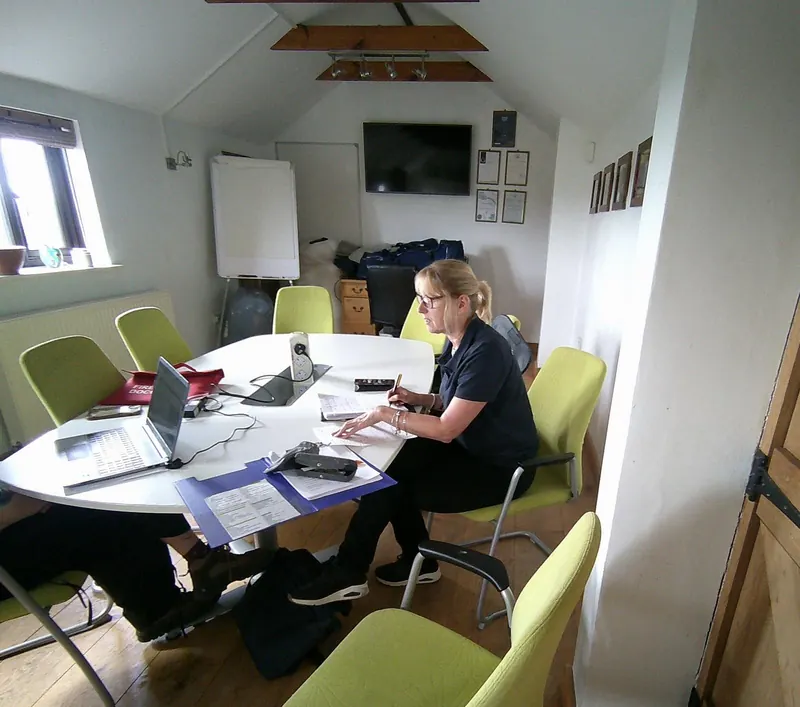
The Order sets no expiry date. It requires regular review, especially if there is reason to suspect the assessment is no longer valid or after a significant change. The guide says “An annual review is usually appropriate”, and Cornwall Fire and Rescue Service recommends at least annually: good practice, not a statutory deadline.
The rules owners often mix up
Three other sets of rules need separating out:
- Gas safety checks — regulation 36 of the Gas Safety (Installation and Use) Regulations 1998 applies where premises are occupied for money under a lease or licence. It requires gas appliances and flues to be safety-checked at least every 12 months, with a record. Health and Safety Executive guidance includes rented holiday accommodation.
- Smoke and carbon monoxide alarm rules — the Smoke and Carbon Monoxide Alarm (England) Regulations 2015 are written for tenancies where the property is someone's only or main home. They do not set a holiday let's alarm requirements. For smoke and heat alarms, start with the Fire Safety Order and the Home Office guide, which also recommends carbon monoxide detectors.
- Electrical safety rules — the 2020 electrical safety regulations for rented homes likewise cover tenancies where the property is the tenant's only or main residence. For a holiday let, five-yearly testing is the guide's recommendation, not a requirement of those Regulations.
Who enforces fire safety in Cornwall
The Order is enforced by the local fire and rescue authority; in Cornwall, that work falls to Cornwall Fire and Rescue Service. The guide says your local service “may inspect your property”, but “they cannot carry out fire risk assessments for you.”
The service can serve enforcement notices, which allow at least 28 days to put things right. Where it considers the risk serious enough to stop or restrict use of the premises, it can serve a prohibition notice, which can take effect immediately. Under article 32, it is an offence to fail to meet the fire safety duties in a way that puts people at risk of death or serious injury in case of fire. It can bring an unlimited fine and, on indictment, up to two years' imprisonment.
In April 2025, a self-catering holiday let business in St Ives was ordered to pay £33,658 in fines and court costs. It pleaded guilty to charges under the Order, including failing to make a suitable and sufficient risk assessment.
When to bring in a fire risk assessor
If you do not feel confident assessing the risk yourself, the guide says “you should engage the services of a competent fire risk assessor”, and points to specialist help or fuller guidance when:
- Guests use a first-floor inner room — and you cannot reasonably change how it is used.
- The layout falls outside the guide — such as a two-storey property with an open-plan ground floor.
- The construction is in doubt — such as whether lath and plaster walls are in good enough condition.
If you get help, the guide says “you remain legally responsible”. See also choosing a competent fire risk assessor and what happens during the visit.
About Property Assessments for Landlords Services Ltd (PALS)
Property Assessments for Landlords Services Ltd (PALS) carries out fire risk assessments and HHSRS assessments across Cornwall, and one visit can cover both. Our assessors, Amanda (Mandy) Evans (NFRAR No. 1776) and Tracy Tully (NFRAR No. 1779), are registered at Intermediate level on the National Fire Risk Assessors Register, with over 20 years' combined experience in local authority housing enforcement. Call 07427 611624 or get in touch.